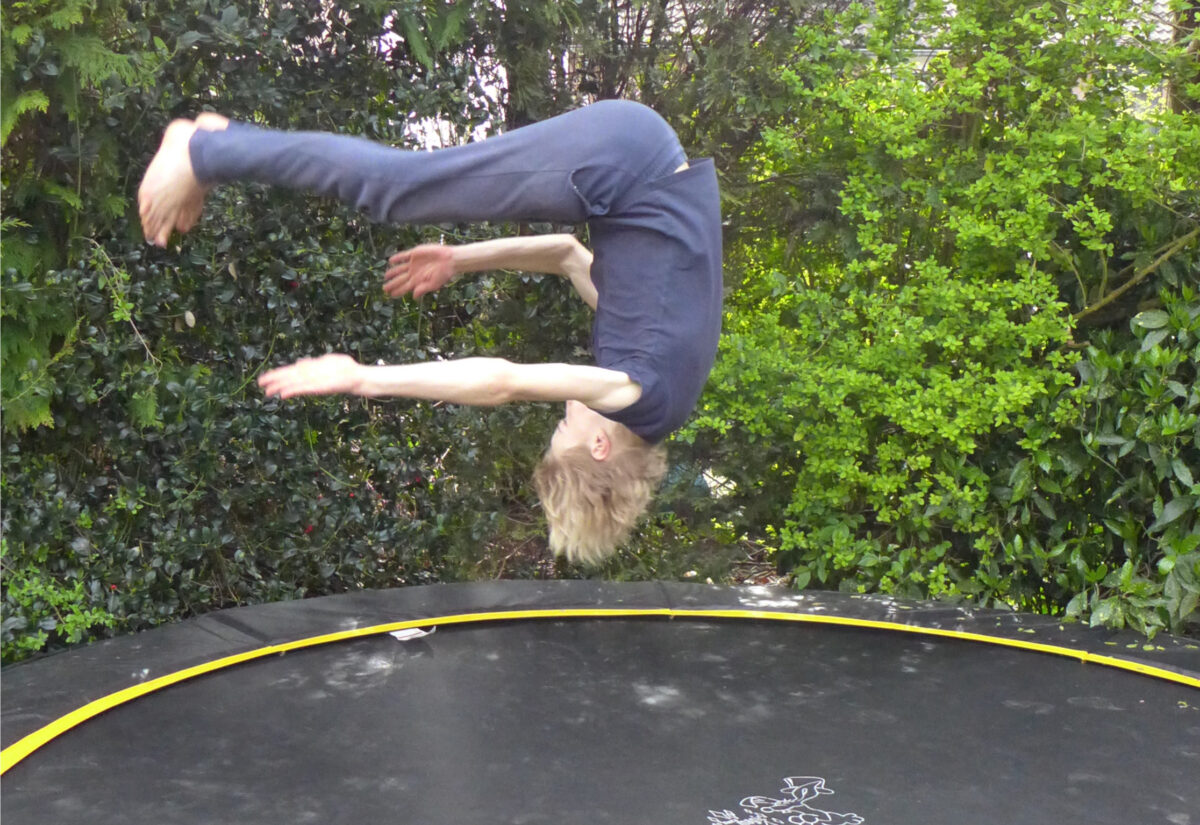
This is a small Q&A with my father about the backflip. I hope you enjoy it! It provides a stepwise description of the process of learning the flip.
Q: Why is the backflip (backward somersault) the most important flip?
Because it’s the foundation for many other different flips.
Q: Like what flips, for example?
Like the Kaboom, the Cody, double backflips, backfulls, and all their variations.
Q: Okay. So is the backflip the first flip you should learn?
Well, the front flip and the backflip are actually the first two.
Q: Is the front flip easier?
Well, to learn, yes.
Q: But if you can’t do any flips at all yet, is it better to start with the front flip or the backflip?
Well, you’ll probably find the front flip easier to learn, because for that, you basically just have to do a forward roll and then keep bouncing more and more. And then you’re basically already doing a forward somersault.
Q: What do you mean by bouncing?
Jumping more and more to go higher on the trampoline.
Q: Oh, right.
But with a backflip, that’s harder, so that’s why most people can do a front flip before they can do a backflip. Because it’s harder to learn.
Q: Okay. And which one did you learn first?
First the front flip. And then the backflip. And maybe the Barani too.
Q: And how did you learn the backflip?
Well, at first I could already jump a little onto my back and then spin backward. I could already do that.
Q: What exactly do you mean?
It’s kind of like a pullover.
Q: What’s a pullover?
It’s falling onto your back on the trampoline. And then you flip backward.
Q: You bounce on your back?
Yes.
Q: And when you bounce back up, you flip?
Yes.
Q: And how many degrees? A 180-degree turn?
Yes, about that.
Q: And then you land on your stomach?
Yes, or on your hands and knees, or if you’re good at it, you land on your feet.
Q: Oh, right, standing up is 270 degrees. And then what? So that’s actually the second step. Because if you were to describe the four steps of the backward somersault, what are they?
- The first step is the backward roll. That’s the basis of turning backward on the trampoline.
- Then you have the pullover. That’s where you let yourself fall onto your back and then bounce back up and turn backward. That’s the second step. So you jump on your back and then bring your legs backward. And then the rest of your body is pulled over you. That is why it is called a pullover.
- After that, you have the back handspring. That’s where you turn backward, jump onto your hands, and then bounce through.
- And then the backward somersault is basically a back handspring without putting your hands down. That’s the fourth step.
Q: What is a back handspring?
A back handspring is when you go backward and then put your hands down. So yeah, you bounce a little on the trampoline. Then you spin backward so you land on your hands. And then you finish the spin.
Q: Do you go over your head or not?
You go over your head backwards.
Q: So you have a sort of intermediate landing.
Yes, it’s a backward somersault, but with an intermediate landing.
Q: We’ve gone through all the steps of the backflip. So back roll, pullover. And then?
Back handspring, and then the backflip. There are also some intermediate steps between the pullover and the back handspring. But they don’t really have a name.
Q: Okay, good. How long did it take you to learn it?
Well, I don’t know exactly how long it took me. I was stuck on the pullover for quite a while. But I didn’t really have the steps from the pullover to the backward somersault either. So actually, in the end, I just did it. In one go, without the back handspring in between.
Q: Oh, but where did you learn that you’re supposed to do the other steps first?
Well, that’s just in hindsight. That’s a much easier way to do it with smaller steps.
Q: Did you read that or did you come up with it yourself? Or do you think that’s actually how it is?
Yeah, that’s really how it is. I’ve seen it done that way before.
Q: But it seems pretty hard to me to land properly when you flip backward with the back handspring. So you don’t tip over too far or anything.
Well, if you tip over too far, you just land on your hands and feet. That’s actually not a big deal at all. And there are also intermediate steps where you do a back handspring, twisting diagonally over one shoulder. That way, you can’t really land on your head. You just land on your side.
Q: And if you can do the backward somersault, what is it the foundation for, you said?
It’s the foundation for a lot of other flips where you rotate backward. Like the Kaboom, Cody, backfull, or the double backflip.
Q: Which of those can you do?
I can do all of those. But there are also a lot of things I can’t do yet. Like doing a backflip and a backfull in succession in the air. And things like that.